Table of Contents
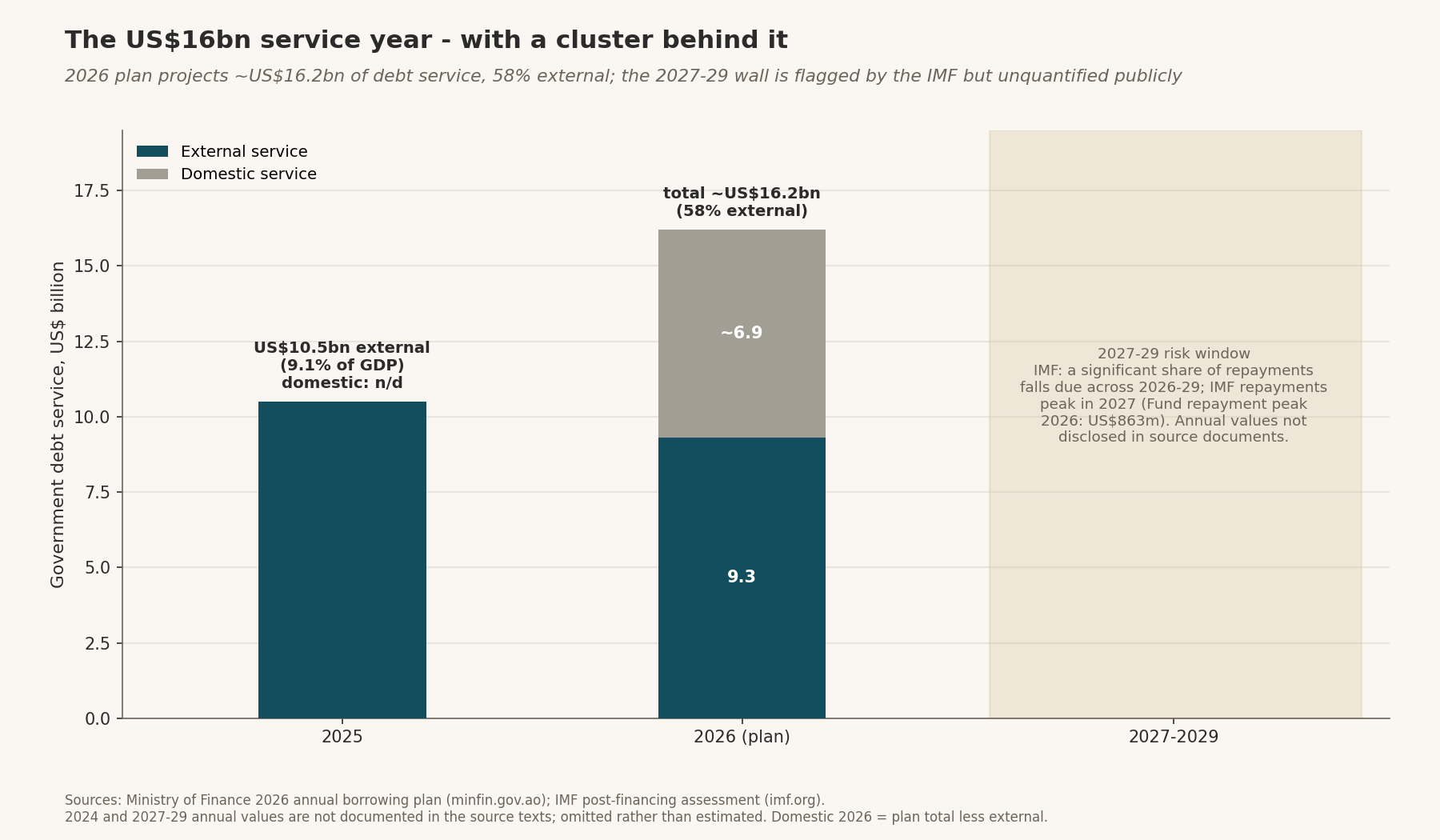
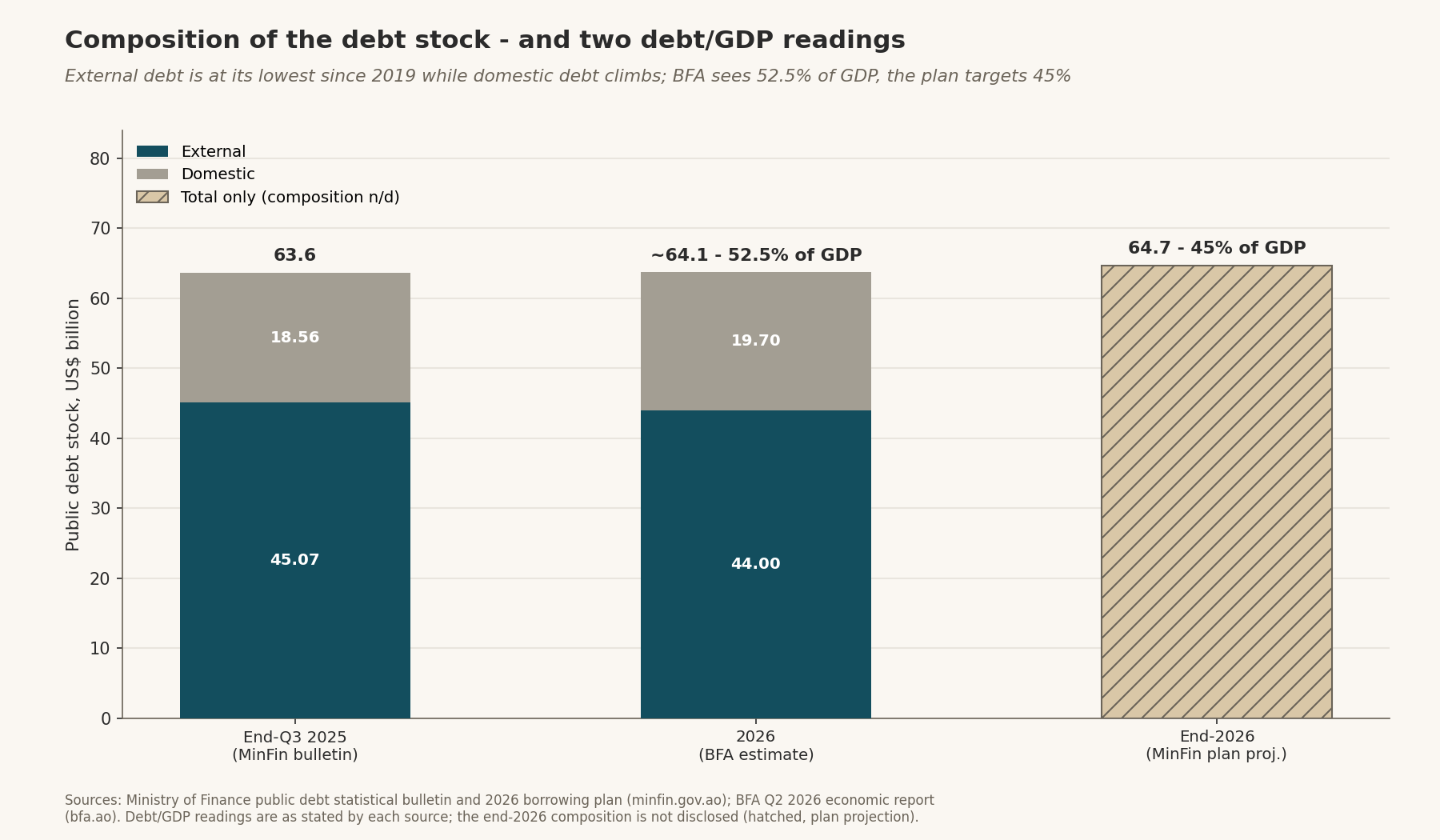
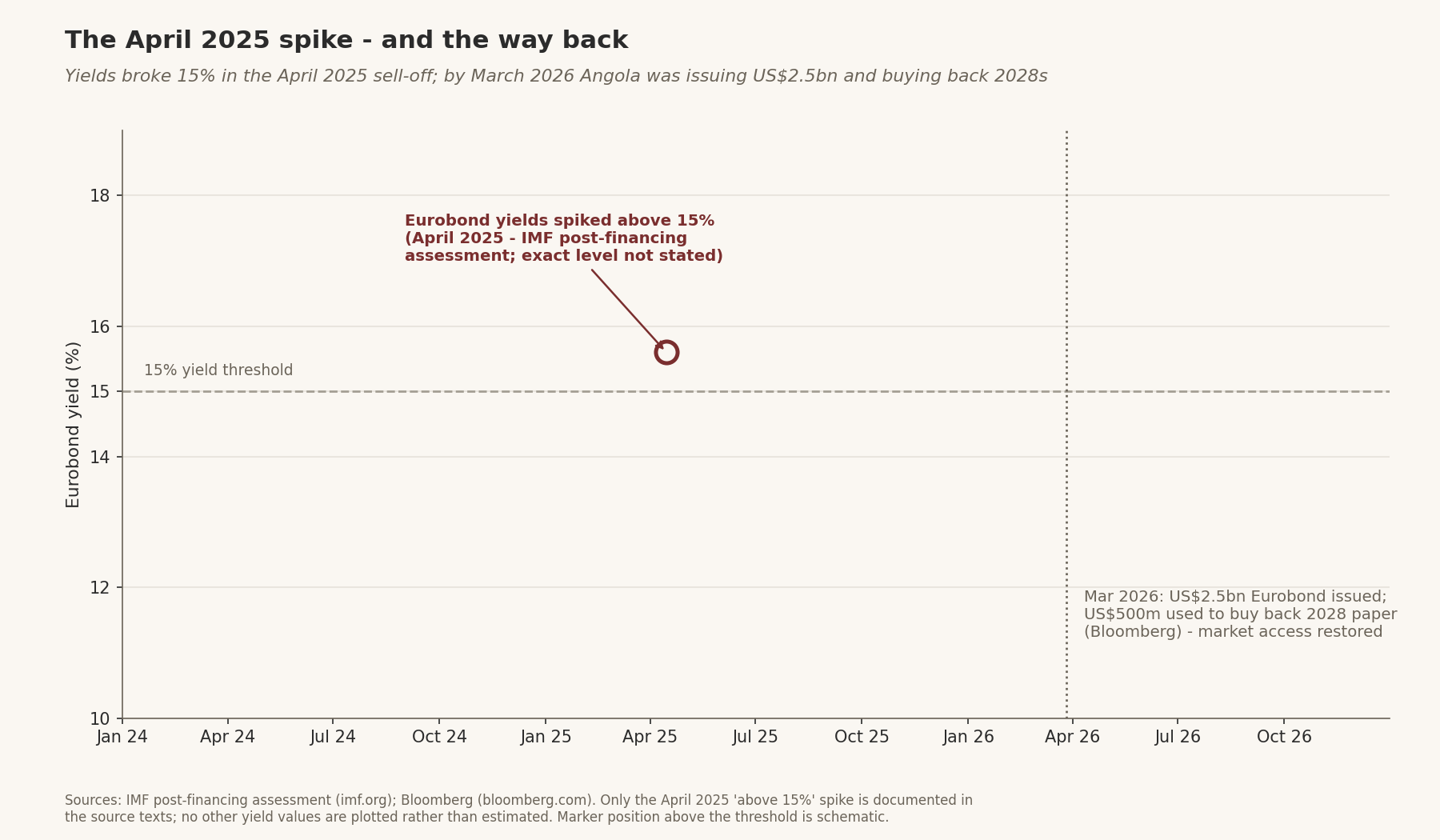
Executive summary. Angola's 2026 financing task is large, front-loaded, and dominated by external repayment. The government's own borrowing plan targets gross financing of about AOA 15.03 trillion (US$15.95 billion) and projects government debt service of about AOA 15.24 trillion (US$16.17 billion), of which roughly 58% is external, with a projected end-2026 debt stock near US$64.7 billion, or 45% of GDP, per the Ministry of Finance's 2026 annual borrowing plan. Angola has met the first part of that task on favourable terms — a US$2.5 billion Eurobond in March 2026, with US$500 million allocated to buying back 2028 paper, per Bloomberg. The binding constraint is not access; it is that debt service now approximates oil tax revenue while oil output is flat at best.
Key judgments.
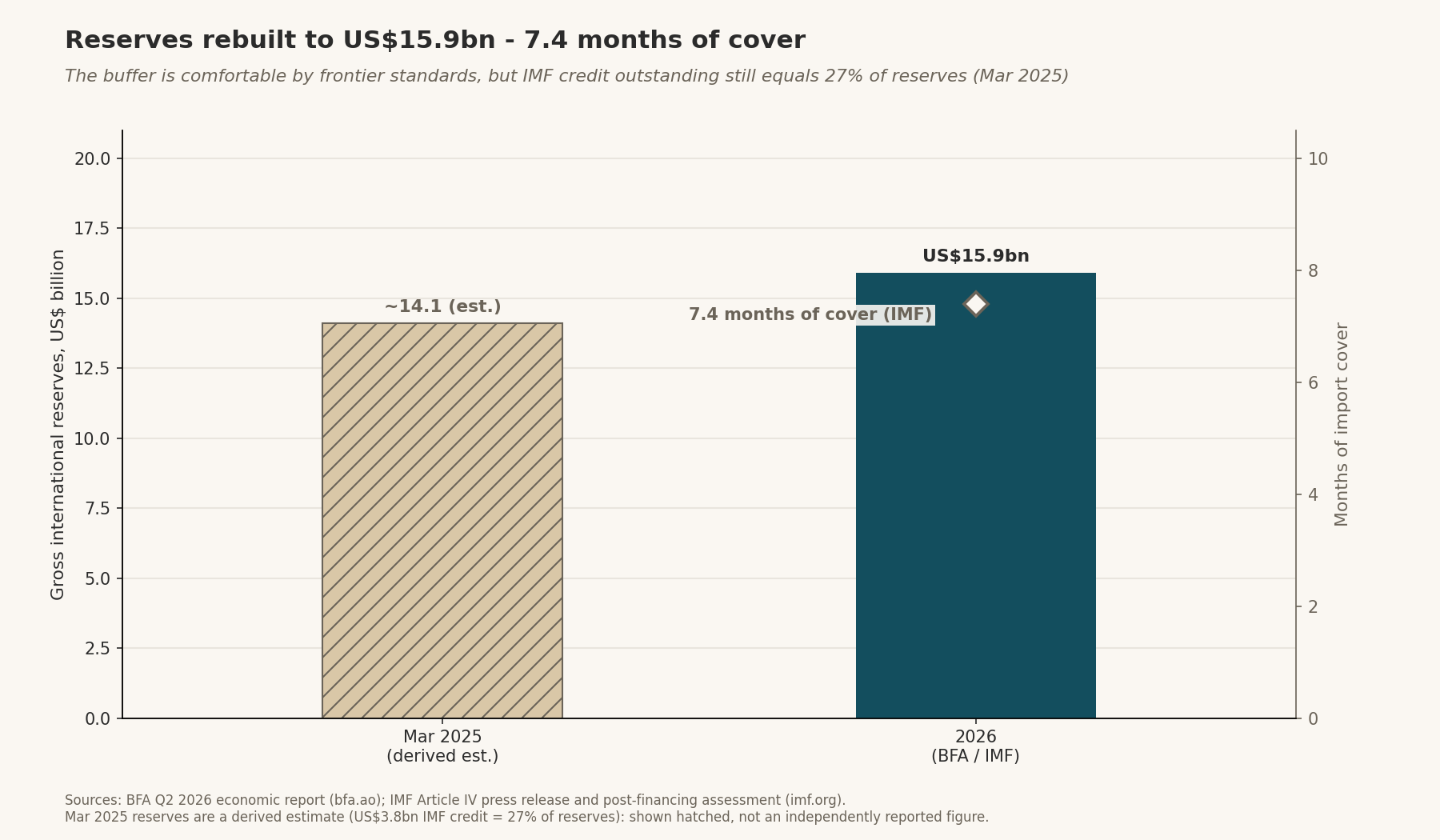
1. Angola can most likely finance 2026 without distress, given demonstrated market access, reserves at 7.4 months of import cover, and a domestic issuance channel. 2. The 2027–29 window is the risk period. The IMF has flagged a significant share of repayments falling due across 2026–29, with IMF repayments as a share of reserves peaking in 2027.
3. Oil price and volume, not policy, dominate the outcome. A larger-than-projected fall in either would require additional external borrowing and weaken repayment indicators. 4. Fiscal savings from subsidy reform are the only large domestic offset available at scale, and their delivery is now politically constrained.
5. Liability management — buybacks, tenders, and tenor extension — is likely to remain the main tool while spreads are compressed.
Background. Angola completed an IMF Extended Fund Facility and has since been under post-financing assessment and Article IV surveillance. Outstanding IMF credit was SDR 2.8 billion (US$3.8 billion, 384% of quota, 27% of gross international reserves) in March 2025, with nominal repayments to the Fund projected to peak in 2026 at US$863 million, per the IMF post-financing assessment.
Evidence.
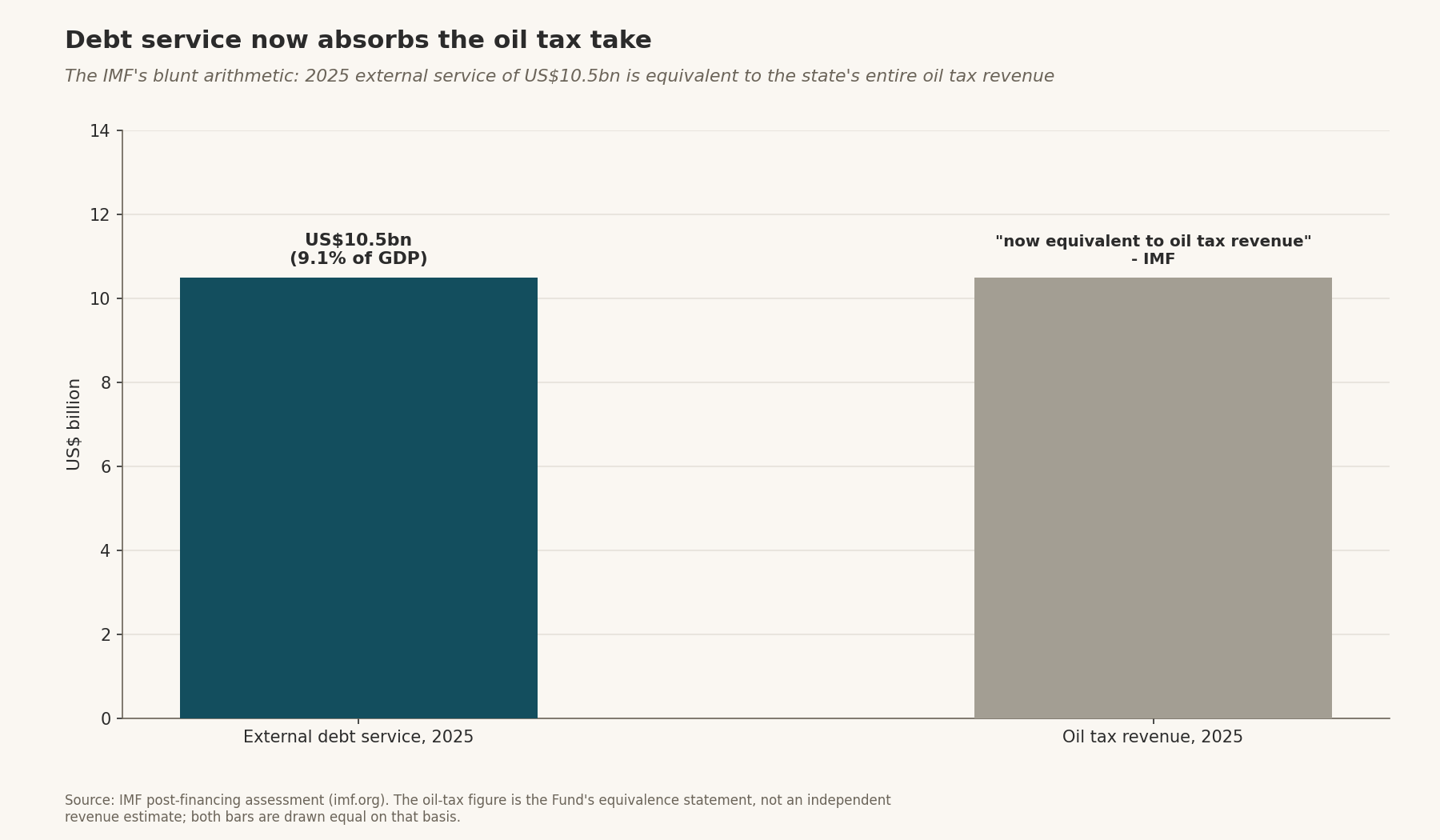
2025 external service: projected at US$10.5 billion, or 9.1% of GDP, with the Fund noting the total is "now equivalent to oil tax revenue" — IMF post-financing assessment.
2026 plan: external service of about AOA 8.77 trillion (US$9.3 billion), split between amortisation and interest, with domestic service at 42% of total — Ministry of Finance borrowing plan.
Stock composition: external public debt fell to US$45.07 billion by end-Q3 2025, the lowest since 2019, while domestic debt rose to US$18.56 billion — Ministry of Finance public debt statistical bulletin.
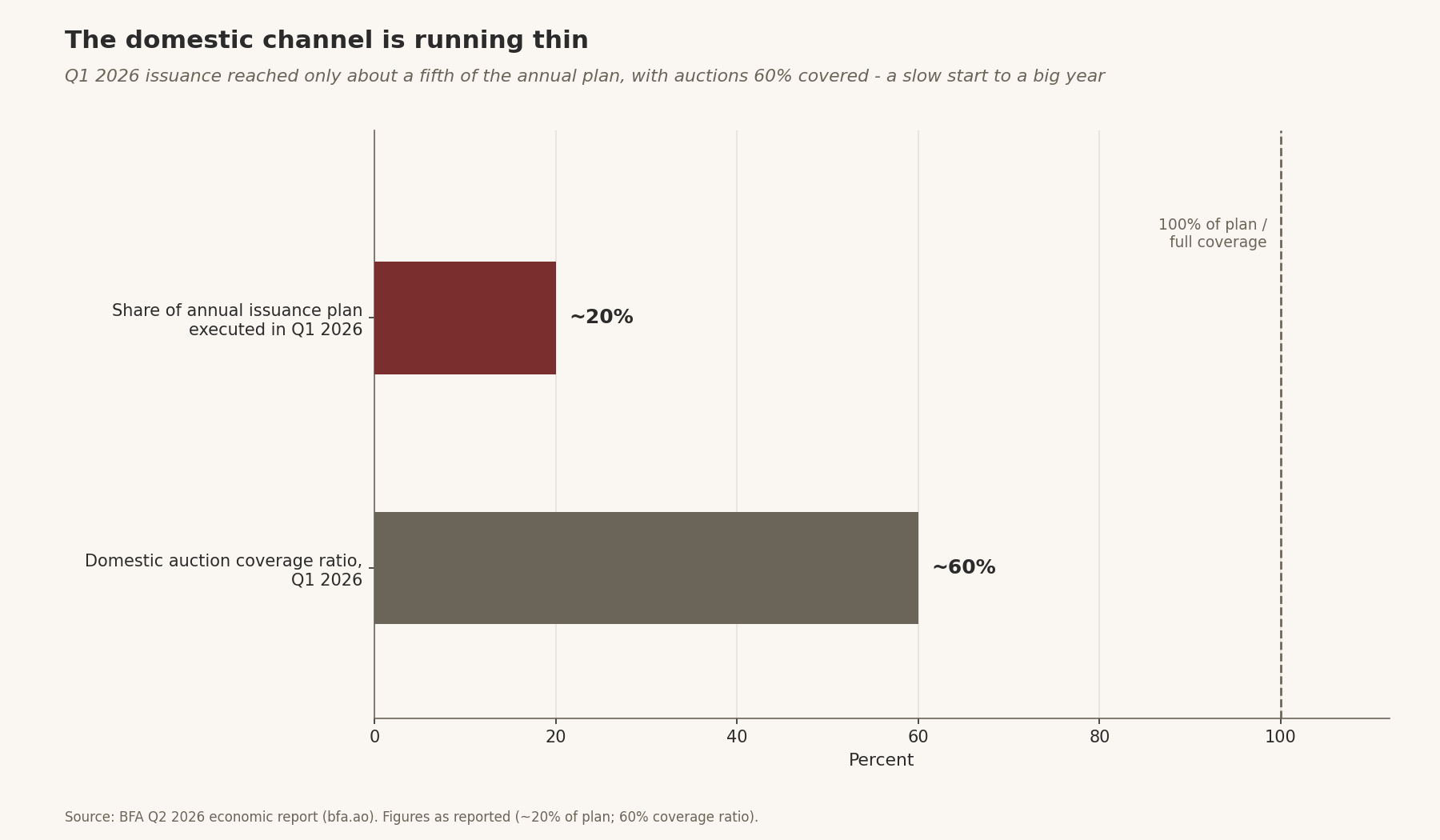
Bank-sector view: total debt around US$64.1 billion in 2026, external US$44 billion, domestic US$19.7 billion, estimated at 52.5% of GDP, with reserves of US$15.9 billion; Q1 2026 domestic issuance ran at only about 20% of the annual plan with a 60% coverage ratio — BFA Q2 2026 economic report.
Fiscal outcome: deficit of 4.1% of GDP in 2025; reserves at 7.4 months of cover; Directors urging windfalls go to debt reduction — IMF Executive Board press release.
Pricing memory: Eurobond yields spiked above 15% in April 2025 — IMF post-financing assessment.
Scenarios (to 2029).
Base — "term out and grind" (most likely). Oil holds near 1.0–1.1 million b/d, Brent range-bound, spreads stay compressed. Angola rolls maturities with periodic buybacks, debt/GDP drifts around the mid-40s to low-50s, and adjustment falls on capital spending.
Upside — "windfall discipline". A sustained oil price gain plus adherence to the Fund's instruction to apply windfalls to debt produces faster deleveraging and a ratings-positive trajectory. Requires resisting the historical pattern of pro-cyclical spending.
Downside — "price and access shock". A material oil decline coincides with wider frontier spreads. External service near US$9–10 billion a year meets weaker revenue; the state leans harder on domestic issuance at higher yields, tightening the sovereign-bank nexus the FSAP already flagged.
Indicators to monitor. Monthly ANPG output versus 1.0 million b/d; Brent versus budget assumption; kwanza versus the market-clearing rate; reserves in months of cover; domestic auction coverage ratios; Eurobond spread versus the 2025 peak; realised subsidy savings versus the 2.1% of GDP target; FATF action-plan completion; and any change in the Fiscal Sustainability Law ceiling headroom.
Risks. Oil price and volume shock; refinancing at higher coupons; sovereign-bank feedback through domestic debt holdings, legacy NPLs, and FX liquidity imbalances flagged in the IMF FSAP stability assessment; social resistance to further subsidy adjustment; and contingent liabilities from state-owned enterprises, including a Sonangol privatisation now deferred to 2027, per Plataforma Media.
Charts & visuals
X: Angola's 2026 plan: ~$16bn of debt service, 58% external, against a 45% debt-to-GDP target. It has already raised $2.5bn and spent $500m of it buying back 2028s. Our report on the 2026–29 repayment cluster →
LinkedIn: New Axis Report: Angola's 2026–2029 debt wall. The government's own borrowing plan projects about $16.2bn of debt service this year, 58% of it external, with a debt stock near $64.7bn. The IMF has said the total is now equivalent to oil tax revenue. Angola has market access — $2.5bn priced in March, $500m directed to a buyback — but access is not the constraint. Output flat at one million barrels a day is. Three scenarios to 2029, with the indicators to watch.
New Axis Insights corrects errors promptly. To report one, email corrections@newaxisinsights.com. See our corrections record.